Loneliness Among Foreign-Born Older Adults in Finland: A 2025 Survey
In the spring of 2025, the Jututtaja project organised workshops on loneliness across Finland. The survey targeted Estonian-, Russian-, and Arabic-speaking older adults in the country, specifically:
- Arabic-speaking older adults aged 55+
- Estonian- and Russian-speaking older adults aged 60+
A total of 112 people (N=112) participated in the workshops: 11 Arabic-speaking, 31 Estonian-speaking, and 70 Russian-speaking.
The participants responded to a total of 54 questions/statements. Methods included interviews, online surveys, and group workshops. The survey provides insight into the experiences of loneliness and everyday challenges faced by these different language groups in Finland.
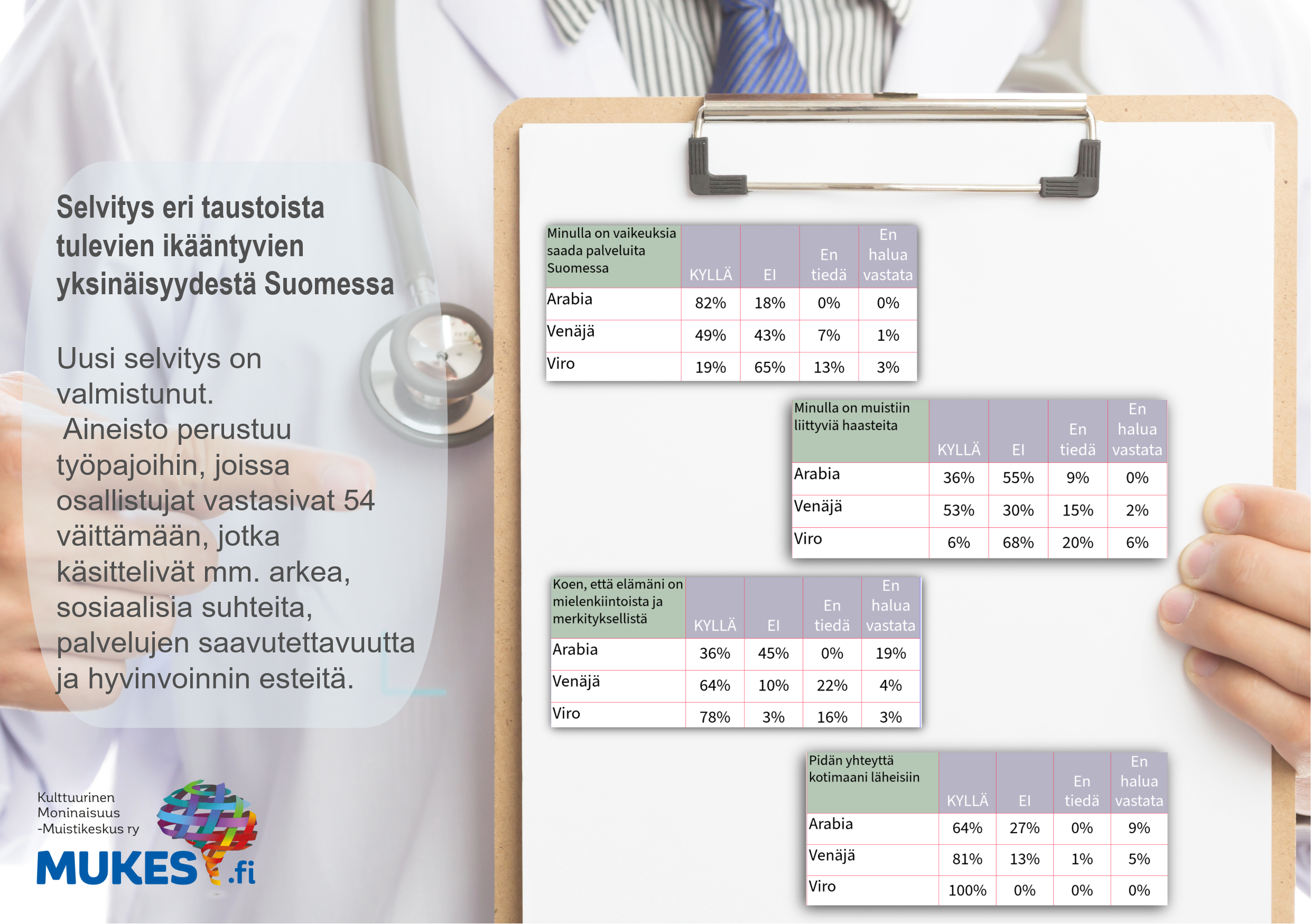
During the workshops, participants reflected on loneliness, its causes, and shared their wishes and expectations.
They responded to various statements using the options: “Yes,” “No,” “Don’t know,” or “Prefer not to answer.” The last two options were included at the request of older participants, allowing everyone to respond in a way that suited them. Methods included interviews, online surveys, and group workshops.
Note: This is not a formal research study. It is a survey based on discussion and shared experiences, using multiple methods to reach different groups.
Workshops were held in Helsinki, Vantaa, Kotka, Jämsälä, and Jyväskylä.
We extend our warm thanks to all our partners who made the workshops possible and helped us reach the participants!
Read the survey results here: Loneliness Among Foreign-Born Older Adults in Finland: A 2025 Survey

Growing Old in a Foreign Language: Experiences of Older Adults in Finland
What is it like to grow old in a country whose language is not your own? A 2025 survey of Arabic-, Estonian-, and Russian-speaking older adults in Finland explores this question, revealing a daily life shaped by both challenges and resilience. For those who move to Finland later in life, the journey carries a lifetime of experiences: childhood landscapes, cultural habits, and their native language, along with the hope of a new beginning. Over time, health can decline and daily life slow, making everyday tasks more complex in a foreign language. Booking medical appointments, completing digital forms, and understanding official letters from social security agencies can be daunting. Interpreters are not always available, and the language of authorities often feels heavy and difficult to navigate. Many rely on their children, which can be painful as it challenges their sense of independence. Fear of mistakes, shame, and uncertainty are common companions.
Loneliness appears in many forms: silent homes, empty evenings, or weekends without activities. While respondents express a strong desire to connect with Finns, language barriers often limit interaction. At the same time, their own communities provide safety and a sense of belonging. More than half of the respondents report experiencing discrimination, reflected in looks, tones of voice, and service situations, and many feel that their education and skills are undervalued in Finland. Weakening connections with children and grandchildren, particularly in cultures that highly value the role of grandparents, adds to the sense of isolation.
Despite these challenges, the survey highlights remarkable resilience. Respondents maintain dreams, a desire to learn, and a wish to contribute to society. They want to participate actively and feel useful. Family, community, and hope for the future provide strength, demonstrating that belonging and engagement matter as much as practical services. These findings underline that aging is about more than healthcare or social support—it is about recognition, inclusion, and human connection. Older adults who do not speak Finnish need understanding that transcends language barriers, opportunities to be heard, and the chances to participate fully in community life.
Finland has the opportunity to be a place where aging is not experienced as temporary or marginal, but as meaningful and safe, for everyone—including those for whom Finnish is not a native language. By embracing both challenges and resilience, society can support older adults in growing roots anew, strengthening their communities, and contributing to life in Finland with dignity and hope.
Read the survey results here: Loneliness Among Foreign-Born Older Adults in Finland: A 2025 Survey
Text by Ann-Ly Palosaari
Translated by Siiri Jaakson
Loneliness Among Foreign-Language Older Adults in Finland - A Scoping Literature Review
Master’s Thesis
Author:
Anne-Ly Palosaari
Institution:
Turku University of Applied Sciences
Degree Programme:
Integration of Rehabilitation and Physical Activity
Year:
2025
Project affiliation:
This thesis was carried out as part of the Finnish Centre for Cultural Diversity and Memory, Jututtaja Project.
Abstract
The thesis was carried out as part of the Finnish Centre for Cultural Diversity and Memory, the Jututtaja project. This thesis examined loneliness and social isolation among foreign-language older adults, and during the process, developed a tool for
professionals to support the identification of these issues.
The aim was to enhance understanding of the well-being of ageing migrants and to identify key factors influencing loneliness. The material consisted of a scoping literature review (21 studies) and workshop data collected in 2025 as part of the Jututtaja project involving 112 foreign-language older adults.
The results showed that loneliness is increased by limited language skills, small social networks, cultural differences, financial strain, discrimination and difficulties accessing services. Protective factors included family support, cultural belonging and a strengthened sense of personal identity. Based on the findings, an assessment tool was developed to help professionals identify loneliness-related risk factors in four areas: social relationships, language and culture, health and daily life management, as well as financial and environmental factors.
The thesis provides a tool to improve and to promote the preventive work and well-being of foreign-language older adults.
Keywords:
Immigrants, older adults, loneliness, social isolation
Read the thesis here: Loneliness Among Foreign-Language Older Adults in Finland - A Scoping Literature Review
Takaisin